Dusky Proxima A — A 12-Watt 6V6 Head You Can Only Get Until October 7
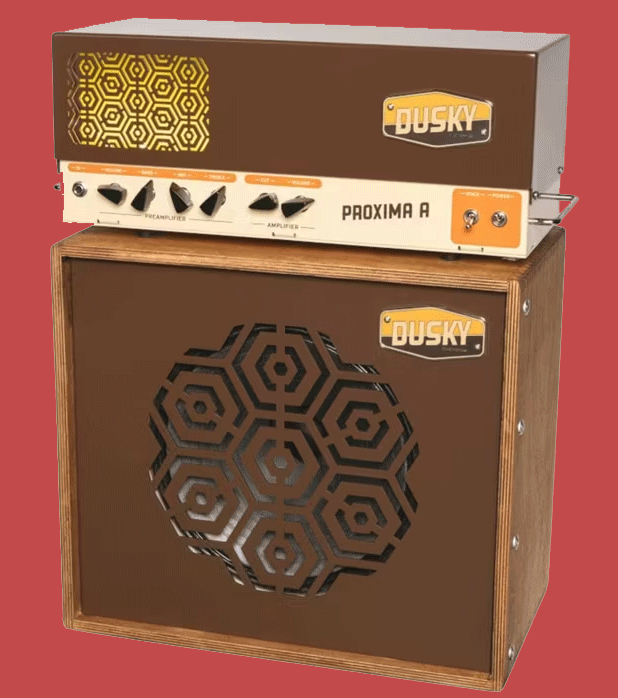
Here is the part Dusky Electronics buries at the bottom of the announcement: the Proxima A is only orderable until October 7th. After that, the preorder window closes, the batch goes into production, and future batches will be different amps entirely. Each run is unique. So this specific 12-watt, cathode-biased 6V6 head, built in Durham, North Carolina, is a thing you can buy for about eleven weeks and then never again. It is $3,100. The matching 1×12 cab is another $895. In a year when every amp announcement is a modeler, that is a genuinely defiant piece of gear.
Preorder direct from Dusky Electronics or select dealers.
SPEC SHEET
| Model | Dusky Electronics Proxima A |
| Type | All-tube guitar amplifier head |
| Power | 12 watts |
| Power Tubes | Pair of cathode-biased 6V6GT |
| Voice Switch | 3-way, different colors of gain and frequency sculpting |
| Master Volume | Buffered post-phase-inverter, designed to avoid tone suck |
| Tone Controls | Bass, mid, treble, volume; simple interface, wide range |
| Lineage | Follow-up to Dusky’s award-winning D₂O amplifier |
| Optional Cab | Proxima 112: open-back 1×12, aluminum speaker baffle, Weber Vintage Series speaker |
| Built In | Durham, North Carolina, USA |
| Availability | Preorder only, closes October 7, 2026; then production to fill orders |
| Head Price | $3,100 |
| Cab Price | $895 (full rig: $3,995) |
THE BATCH MODEL IS THE STORY
Most amp companies build a model and sell it until demand dies. Dusky is doing the opposite. The Proxima A is available for preorder until October 7th. When that window closes, they build exactly the orders they took, and then they move on. Their own language is explicit: future batches will feature different models, and each batch will be unique in some way.
That is a small-builder model with real consequences for a buyer. On the upside, you are getting something closer to a limited run than a catalog item, and small runs mean the builder can actually obsess over each one. On the downside, there is no “think about it for six months and buy one later.” There is no used market yet because none exist yet. And if you love it and want a second one in two years, the answer is likely no.
This is worth saying plainly because it is the entire buying calculus: this is not a decision about whether the Proxima A is a good amp. It is a decision about whether you want this amp, made now, before a deadline. Boutique builders have used scarcity as a marketing lever for years. Dusky is at least being upfront that scarcity is the actual production model, not a manufactured hype cycle.
WHY CATHODE BIAS MATTERS
The single most important spec in that table is three words long: cathode-biased 6V6GT. That is not a cost decision, it is a voicing decision, and it tells you exactly what this amp is going to feel like under your hands.
Quick version, no engineering degree required. Power tubes need a bias, a resting voltage that sets how hard they idle. In a fixed-bias amp, that voltage is locked in and held steady. In a cathode-biased amp, the tubes bias themselves through a resistor, and critically, that bias point moves as you play. Hit a hard chord and the amp momentarily sags before recovering. That sag is compression, and it is the thing players describe as touch sensitivity, bloom, or “the amp breathing with you.”
Cathode bias is also why it is 12 watts and not 20. You give up headroom and efficiency to get feel. That is the classic small-Fender and Vox recipe, the reason a cranked cathode-biased amp sounds alive in a way that a clean, stiff, fixed-bias amp does not. If you have ever wondered why a 12-watt amp costs $3,100 when a 100-watt solid-state head costs $300, this is a large part of the answer: you are paying for how it responds, not how loud it gets.
THE MASTER VOLUME NOBODY TALKS ABOUT
The second spec worth decoding is the “buffered post-phase-inverter power amp volume, free from tone suck.” That is a mouthful, and it is the most practical feature on the amp.
The problem it solves is ancient: a cranked tube amp sounds glorious and is unusable in a room with other humans in it. Standard master volume circuits sit early in the signal path, which means turning down does not just lower volume, it changes the tone, thins out the response, and kills the feel. That is the “tone suck” everyone complains about. A post-phase-inverter master volume sits much later in the chain, after the preamp and phase inverter have already done their work, so you keep the saturation and the interaction of the driven circuit while actually reducing output. Adding a buffer to it is Dusky’s fix for the loading issues that PPIMV circuits can introduce.
Put that together with 12 cathode-biased watts and you get the design intent in one sentence: this is an amp built to be pushed into its sweet spot and then brought down to a volume that will not get you evicted. That is the whole point of a low-wattage boutique head, and Dusky engineered specifically for it rather than bolting a master volume on as an afterthought.
WHAT IT SOUNDS LIKE (AND THE HONEST CAVEAT)
Straight talk: nobody has demoed the Proxima A yet. It was announced July 15th and it does not exist outside Dusky’s bench. Anyone telling you how it sounds right now is guessing, and we are not going to.
What we can point you at is the D₂O, the award-winning amp the Proxima A is directly built on. Dusky says the Proxima A “builds on the trail blazing architecture of its predecessor” with the output section scaled down to 12 watts. That makes the D₂O the closest available reference point for the design language, the tone controls, and the general character. Watch it with the understanding that the Proxima A is a smaller, more compressed, more sag-prone version of that idea.
THE CAB IS NOT AN AFTERTHOUGHT
The optional Proxima 112 cab is $895 and has two details worth flagging. First, it is open-back, which means more air, a wider dispersion, and less low-end thump than a closed cab. Correct choice for a 12-watt amp meant to breathe.
Second, and more unusual: an aluminum speaker baffle. Nearly every guitar cab on earth uses a wood baffle, typically plywood or MDF, and the baffle material meaningfully affects how a cab resonates. Aluminum is significantly stiffer than wood, which generally means less baffle flex, tighter transient response, and a more focused sound with fewer of the sympathetic resonances a wood baffle contributes. It is a deliberate, unusual engineering choice on a small-run cab, paired with a Weber Vintage Series speaker, a well-regarded American-made vintage-voiced driver.
Whether you want that is a real question. Some players love the focus and clarity of a stiff baffle; others want the woody bloom of a flexing one. But it tells you Dusky thought about the cab as part of the instrument rather than a box to ship the speaker in.
$3,100 FOR 12 WATTS, IN THE AGE OF MODELERS
We have spent a lot of ink here on modelers, and it is worth putting this amp next to them honestly. For $3,100 you could buy a Neural DSP Quad Cortex Mini ($1,399), a Positive Grid Reactor 100 ($449), and still have over a grand left over. Those units give you hundreds of amps, thousands of captures, a USB interface, and a rig that fits in a backpack.
The Proxima A gives you one amp. That is not a weakness; it is the entire argument. A modeler is a library. A great tube amp is an instrument you learn. The cathode bias sagging under your pick, the PPIMV letting you crank it in a small room, the open-back cab moving actual air, those are things you play with, not through. Nobody buying a $3,100 hand-built 12-watt head is confused about the value proposition. They have heard the modelers, some of them own modelers, and they want the thing that pushes back.
The honest version: if you are choosing between these on spec, buy the modeler. It wins every spec comparison and it is not close. If you already know why you want a cathode-biased 6V6 head specifically, no spec sheet was going to talk you out of it anyway.
WHO IT’S FOR
Buy the Proxima A if you already know what a cathode-biased 6V6 amp feels like and want a hand-built American one with a master volume engineered to actually work. It is for the player recording at home who needs power-tube saturation without a full-volume room, the small-club gigger who does not need 40 watts, and the buyer who values a builder’s obsession over a feature list. Dusky’s pedals have a real reputation and the D₂O won awards; this is not an unknown quantity making a first swing.
Skip it if you need volume for a loud band without a PA, if you want versatility more than character, or if you are the kind of buyer who needs to hear a thing before spending $3,100. That last one is a completely reasonable position and the preorder model makes it impossible. Also skip it if the deadline is what is making you feel urgent, that is the wrong reason to spend four figures on an amp.
GI VERDICT
There is something I genuinely like about this amp, and it is not on the spec sheet. In a year where nearly every amp release is an AI feature or a modeling engine or a capture format, a small shop in Durham is building a 12-watt tube head in limited batches, telling you exactly when the window closes, and letting the design speak. The specs that matter, cathode bias, a properly engineered post-phase-inverter master volume, an open-back cab with an aluminum baffle and a Weber, are all decisions made by someone chasing feel rather than a feature bullet.
The catch is real and I will not soften it: $3,100 for an amp nobody has heard yet, on a deadline, with no used market and no demos, is an act of faith in the builder. Dusky has earned some of that faith, the D₂O won awards and their pedals are well-regarded. But faith is still what you are buying with. If that trade sounds fine to you, October 7th is your date. If it does not, there is no shame in waiting for the reviews, you will just be waiting for an amp you can no longer order.
— GI
FAQ
How much does the Dusky Proxima A cost?
The Proxima A head retails for $3,100. The optional matching Proxima 112 speaker cabinet is $895, making the full rig $3,995. Both are available direct from duskyamp.com or select dealers.
When does the Proxima A preorder close?
October 7, 2026. After the preorder window closes, Dusky builds the batch to fulfill orders. Future batches will feature different amplifier models, and each batch will be unique, so this configuration may not be offered again.
What are the Proxima A’s specs?
12 watts from a pair of cathode-biased 6V6GT power tubes, a 3-way Voice switch for different gain and frequency colors, and a buffered post-phase-inverter master volume designed to avoid tone suck. It is hand-built in Durham, North Carolina.
What does cathode-biased mean, and why does it matter?
In a cathode-biased amp, the power tubes set their own bias through a resistor, and that bias point shifts as you play. The result is natural compression and sag under a hard attack, which players experience as touch sensitivity and bloom. It trades headroom for feel, and it is why the amp is 12 watts rather than 20.
What is a post-phase-inverter master volume?
It is a master volume placed late in the signal path, after the preamp and phase inverter, rather than early. That lets you drive the amp into saturation and then reduce output while keeping the tone and feel of a cranked amp. Dusky’s version is buffered to avoid the loading issues these circuits can cause.
What speaker is in the Proxima 112 cab?
A Weber Vintage Series speaker in an open-back 1×12 cabinet with an aluminum speaker baffle, an unusual choice versus the standard wood baffle, generally yielding tighter transients and a more focused response.
Is the Proxima A related to the Dusky D₂O?
Yes. It is the direct follow-up to Dusky’s award-winning D₂O amplifier, built on the same architecture with the output section scaled down to a 12-watt 6V6 section, plus a newly designed buffered post-phase-inverter master volume and the 3-way Voice switch.
About GI — GuitarIntel’s gear desk. Decades of guitars in hand, vintage and new, electrics built from scratch, amps modded, pedals stomped. The first thing I ever wanted, as a kid, was a guitar. Everything since has been in service of that. GuitarIntel exists because gear deserves straight talk from someone who loves guitars and gear and might be a little obsessed.
Published July 16, 2026 — GuitarIntel