Marcus King Band Rig Rundown 2026 — Every Guitar, Amp, and Pedal
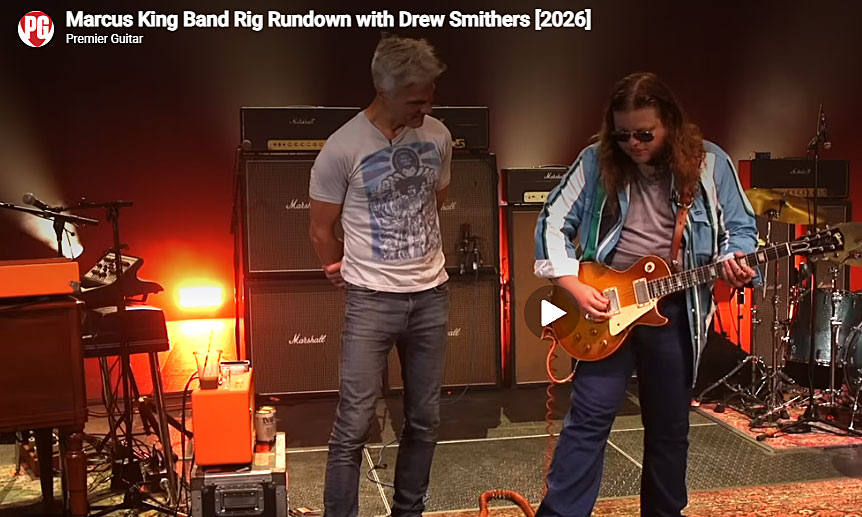
The 2026 Marcus King Band touring setup is a masterclass in vintage tone chasing: real bursts, real Marshall Super Leads, and a pedalboard that leans on cheap, off-the-shelf classics rather than boutique exotica. Premier Guitar caught up with King, his blues-veteran father Marvin, and slide-guitar sideman Drew Smithers for a full rundown. Here is every piece, broken down, with GI’s take on why it works.
MARCUS KING — GUITARS
King’s headline instrument this run is a 1959 Gibson Les Paul, the holy grail of electric guitars and the tonal heart of his lead sound. A real burst on the road is a statement, most players with a genuine ’59 leave it in a vault, and its thick, vocal midrange is exactly what lets King sound like a Marshall stack singing.
Alongside it he runs a 1966 Fender Esquire, the single-pickup Telecaster variant that trades versatility for pure, cutting attack, and a Gretsch G6199 Billy-Bo Jupiter Thunderbird, the wild Bo Diddley-designed body shape that brings a twangier, more percussive voice to the set. That spread, a burst for fat leads, an Esquire for bite, and a Gretsch for character, covers an enormous tonal range from three very different classic platforms.
MARCUS KING — AMPS
The core of King’s tone is a vintage Marshall JMP Super Lead, the plexi-lineage 100-watt head that defined British rock and blues volume. This is the amp his father Marvin talks about in the rundown, a genuine torch-passing moment, and it is the reason King’s overdrive sounds like moving air rather than a pedal. A Super Lead cranked into its sweet spot is the sound of the late ’60s and early ’70s, and King leans into it hard, running a full Marshall backline for that unmistakable stacked-amp roar.
GI note: pairing a ’59 Les Paul with a Super Lead is the single most iconic amp-and-guitar combination in rock history, the “Beano” recipe, the Green/Page/Kossoff blueprint. King is not reinventing anything here. He is playing the canonical setup with the taste to make it his own.
MARCUS KING — PEDALBOARD
Here is where King’s philosophy gets interesting: his board is deliberately cheap and simple. His most famous move is the Ibanez TS9 Tube Screamer, run not as an overdrive but as a mild mid-push, volume around 7 o’clock, drive up near 2 o’clock, to give his cranked amp just a touch of edge without piling on gain. It is the Stevie Ray Vaughan use of the pedal, and King has said he keeps a plain off-the-shelf TS9 rather than any boutique clone precisely because it does the job and you can replace it anywhere.
The rest of the board follows the same honest logic: an Analog Man Beano Boost (a Dallas Rangemaster treble-booster replica, the Clapton “Beano” tone), a Dunlop wah, an Electro-Harmonix Mini Deja Vibe for rotary shimmer, and a Fender Mirror Image Delay for slapback. King is candid that his real vintage pieces, like his actual Echoplex, stay home; the road board is built from reliable, affordable, easily-replaced tools. That is a working professional’s approach, and it is a lesson worth more than any expensive pedal.
DREW SMITHERS — SLIDE SIDEMAN’S RIG
King’s slide-guitar sideman Drew Smithers brings his own vintage-leaning setup. His main guitar is a 2022 Gibson Custom 1959 Les Paul Standard Reissue, a Murphy-lab-era recreation of the same burst spec King chases in original form, paired with a 1964 Gibson SG Junior, the single-P90 workhorse that is a slide player’s secret weapon for its raw, immediate bark.
Smithers runs a modified 100-watt Marshall 1959 (the Super Lead again, the house sound of this band) and keeps a compact, purposeful pedalboard. Different player, same philosophy: vintage-correct core tone, sensible modern tools around it. The two-guitarist front line, King on burst-and-Super-Lead lead work, Smithers handling slide, is what gives the Marcus King Band its layered, Allman-Brothers-descended twin-guitar texture.
THE TAKEAWAY
What makes the Marcus King Band rig worth studying is not the money, it is the restraint. The expensive part, the ’59 burst and the vintage Super Lead, is the tone foundation. Everything bolted around it is cheap, replaceable, and chosen for function over flash. That is how you build a rig that sounds enormous and never lets you down on the road. If you want to chase this sound on a budget, the priority order is clear: a good humbucker guitar, a cranked (or attenuated) British-voiced amp, and a plain Tube Screamer set low. The vintage mojo is nice. The signal chain philosophy is what actually gets you there.
The only problem with John’s rig rundowns is that there is always a pedal I have to buy. Now I have to do a deep dive onthat ColorDriver from Tru-Fi! I have yet to find the last great fuzz pedal for my board.
For more on the vintage Gibson end of this world, see our breakdown of the Gibson L-00 Century and what a real vintage-spec Gibson brings to the table.
— GI. Full rig rundown video courtesy of Premier Guitar.
About GI — GuitarIntel’s gear desk. Decades of guitars in hand, vintage and new, electrics built from scratch, amps modded, pedals stomped. The first thing I ever wanted, as a kid, was a guitar. Everything since has been in service of that. GuitarIntel exists because gear deserves straight talk from someone who loves guitars and gear and might be a little obsessed.
Published July 8, 2026 — GuitarIntel