Neural DSP Quad Cortex Mini Review — The Flagship, Shrunk 50%
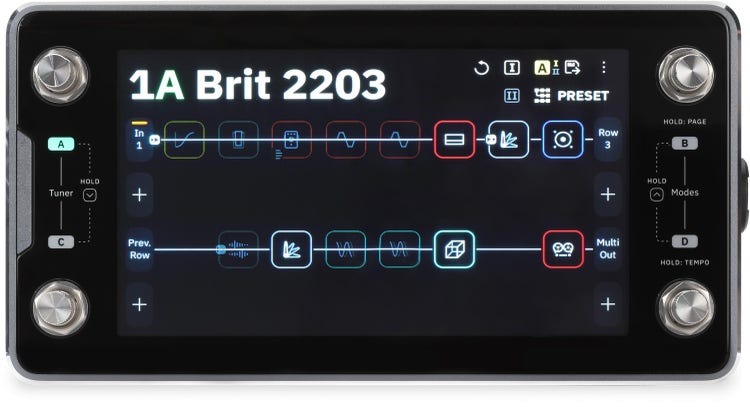
The Neural DSP Quad Cortex Mini is the single biggest amp-modeler story of 2026, and the reason is simple: it is the full flagship Quad Cortex, the same processing, the same Neural Capture engine, the same 90-plus amps and 2,000-plus captures, crammed into a 3.3-pound chassis that is more than 50% smaller. Search interest for “quad cortex mini price” jumped over 3,000% after the reveal. This is not a stripped-down little brother. It is the whole thing, shrunk. Street price: $1,399 (US, Sweetwater exclusive) / £1,129 / €1,299.
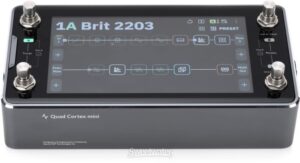
See full specs at the Neural DSP Quad Cortex Mini product page.
SPEC SHEET
| Model | Neural DSP Quad Cortex Mini |
| Type | Compact all-in-one modeling / capture / multi-FX processor |
| Engine | Full Quad Cortex architecture, SHARC quad-core, Neural Capture V1 + V2 |
| Library | 90+ amps, 100+ effects, 1,000+ IRs, 2,000+ Captures |
| Cortex Cloud | Free access to thousands of community Captures |
| Display | 7-inch multi-touch touchscreen |
| Footswitches | 4 stainless steel rotary footswitches (vs 11 on flagship) |
| Modes | Preset, Scene, Stomp, Hybrid; Gig View; Focus + Pages systems |
| Audio Interface | 16-channel USB-C (8 in / 8 out) |
| I/O | Instrument/mic combo input w/ phantom power, balanced XLR out, stereo TRS send/return, MIDI (TRS + USB-C), headphone out |
| Power | Included supply or USB-C 12V DC; locking power connector |
| Size / Weight | 22.8 x 11.8 x 6.5 cm / 1.5 kg (3.3 lb) |
| Ecosystem | Preset + backup sharing with full Quad Cortex; Cortex Control desktop app; plugin (PCOM) compatibility |
| Availability | Sweetwater exclusive (US), shipping July 2026 |
| Street Price | $1,399 US / £1,129 / €1,299 |
THE ONE THING THAT MATTERS
Here is the entire story in one sentence: the Mini is not a new modeler, it is the existing flagship Quad Cortex in a smaller chassis. That distinction is everything. Most compact modelers trade power for size. The Line 6 HX Stomp runs 8 blocks against the full Helix’s 32. The Neural Nano Cortex is capture-only. The Mini breaks that pattern completely, it keeps the full processing architecture, the full amp and effect library, the full Neural Capture V1 and V2 engine, and every workflow feature the flagship has. Nothing is stripped out of the brain. What you give up is physical: eleven footswitches become four, and the I/O is trimmed slightly.
That is why this launch landed harder than any other modeler announcement of the year. Players who skipped the Quad Cortex purely because of its size and weight now have no reason to. For studio, desktop, and fly-rig use, the calculus just changed.
TONE AND WORKFLOW
The tone verdict is not close. Guitar World, a demanding publication, effectively wanted to give it a 6-star rating out of 5 and called it truly exceptional. Neural DSP is arguably the truest plug-and-play modeler on the market, the factory presets deliver mind-blowing, authentic Fender-clean, Marshall-crunch, and EVH-style high-gain tones straight out of the box with almost zero tweaking. Because the Mini carries the full processing power, you can build genuinely complex signal chains that a capture-only or block-limited unit simply cannot.
Neural Capture V2 is the current high point of the platform. It tracks expressive behaviors, amp sag, bloom, volume-knob cleanup, transient response, with a precision that older modelers cannot match, and it shines specifically on touch-sensitive gear like fuzzes, compressors, and dynamic tube amps. If you have used any Neural product recently, you already know the ceiling here is about as high as digital modeling currently goes. For the AI-driven approach in a combo amp instead, the Positive Grid Reactor takes a very different route to a similar goal.
THE FOUR-FOOTSWITCH QUESTION
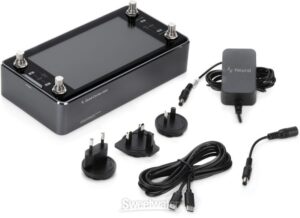
The one real design tradeoff is live control. The flagship has eleven footswitches. The Mini has four rotary footswitches, one in each corner of that big 7-inch screen. Neural addresses this with the Pages system, which lets you cycle through extended footswitch banks without adding hardware, but there is no getting around the fact that four physical switches is fewer than eleven. For a player with a deeply layered live rig who needs many one-tap changes, the full Quad Cortex is still the better stage tool.
For everyone else, and that is most players, the Mini’s layout is fine. In the studio, on a desk, or in a compact fly rig, four footswitches plus the touchscreen is more than enough. MusicRadar summed it up cleanly: as a studio tool, its small, desk-friendly footprint makes it near unbeatable.
MINI VS THE FIELD
vs. full Quad Cortex ($1,799): same engine, same sound, same library. You save $400 and a lot of size and weight. You lose seven footswitches and some I/O. Presets and backups move freely between the two. If you do not need eleven switches for live use, the Mini is the smarter buy and the money stays in your pocket.
vs. Line 6 HX Stomp: the HX Stomp is cheaper and smaller still, but it caps at 8 blocks and runs an older-generation engine. The Mini runs the full flagship brain with no block limit. Different tiers, the Mini is the premium compact option.
vs. Darkglass Anagram ($1,299): the Anagram wins on open NAM support and price. The Mini wins on the maturity of Neural’s stock library, Cortex Cloud, and the plug-and-play factory tones. If you live in the open NAM ecosystem, Anagram. If you want the most refined out-of-box experience, Mini.
vs. Valeton GP-180 ($179): not a real competitor on capability, but worth naming for budget context. The GP-180 does NAM and modeling at a tenth of the price with a fraction of the DSP. If $1,399 is out of reach, that is where to look.
WHO IT’S FOR
Buy the Quad Cortex Mini if you want the best plug-and-play modeling tone available, you record direct or gig through a PA, and you value a compact, desk-and-pedalboard-friendly footprint. It is the near-perfect studio modeler and an excellent fly-rig brain. If you already own a full Quad Cortex, the shared ecosystem makes the Mini a natural second, portable unit that mirrors your rig exactly.
Skip it if your live show demands many one-tap footswitch changes, in that case the full Quad Cortex earns its extra size. And weigh the price honestly: at $1,399 it is only $400 under the flagship and considerably more than an HX Stomp or the Anagram. The Mini is a premium product at a premium price. The one knock every reviewer raised is exactly that, it could have been positioned lower.
GI VERDICT
The Quad Cortex Mini is the rare compact product that makes no real sonic compromise. It is the full flagship engine, the same captures, the same tones, the same near-unbeatable plug-and-play experience, in a chassis you can throw in a backpack. For studio and desktop players especially, it is close to the perfect modeler, and the fact that it shares presets and backups with the full Quad Cortex makes it a no-brainer companion for anyone already in the ecosystem.
The only thing standing between it and a flawless verdict is the price. At $1,399 it sits just $400 below the flagship, close enough that the value gap is narrower than the size gap suggests. If Neural had landed this at $999 it would be an instant, universal recommendation. At $1,399 it is still the best compact modeler money can buy, just not the bargain it could have been. If the footprint is what kept you from a Quad Cortex, your wait is over.
— GI
About GI — GuitarIntel’s gear desk. Decades of guitars in hand, vintage and new, electrics built from scratch, amps modded, pedals stomped. The first thing I ever wanted, as a kid, was a guitar. Everything since has been in service of that. GuitarIntel exists because gear deserves straight talk from someone who loves guitars and gear and might be a little obsessed.
Published July 6, 2026 — GuitarIntel