Darkglass Anagram Guitar Essentials Review — The NAM Machine That Beats the Quad Cortex
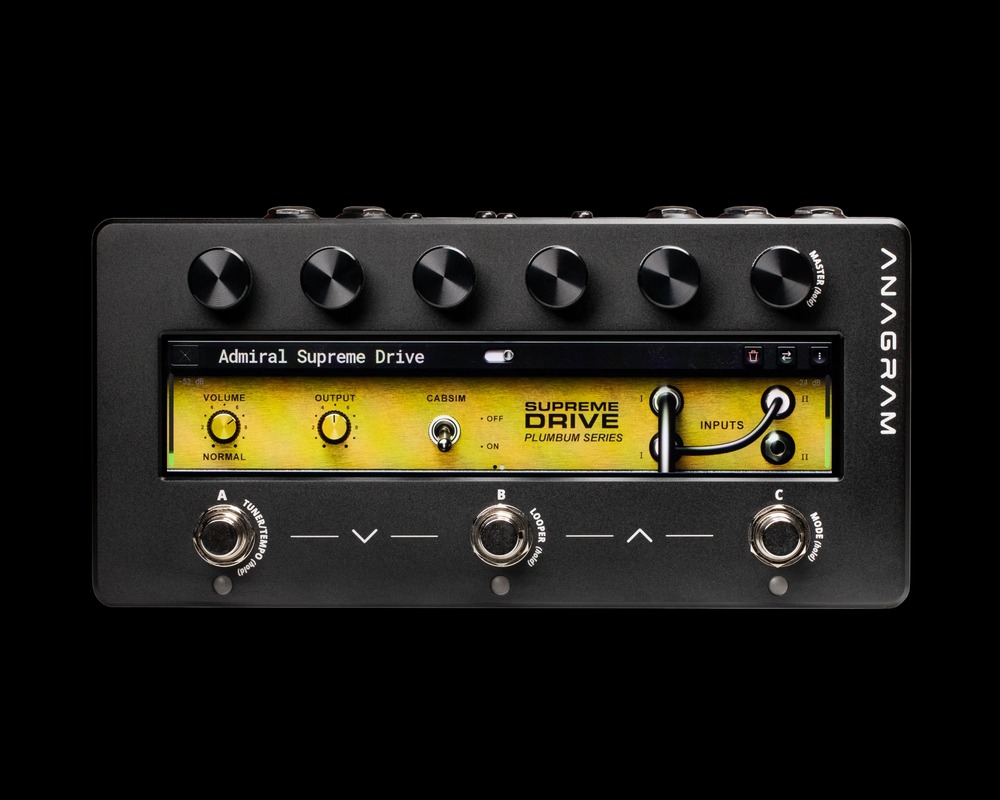
Darkglass built its reputation on bass. The Anagram Guitar Essentials is its first swing at guitar players, and it lands with one spec nothing else in this size class can touch: a hexacore processor running three Neural Amp Modeler profiles at once, at 1.3ms latency, with open access to 10,000-plus community captures. It is a Sweetwater and Andertons exclusive, a one-time limited run, and it is priced at $1,299. The honest version of this review: the built-in amp models are the weak part, the NAM engine is the reason to buy it. Street price: $1,299 (US) / £999 (UK).
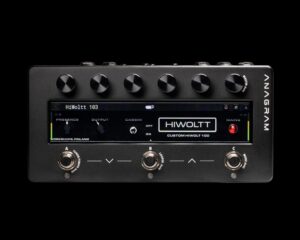
See full specs at the Darkglass Anagram Guitar Essentials product page.
SPEC SHEET
| Model | Darkglass Anagram Guitar Essentials (Limited Edition) |
| Type | Multi-FX / amp modeler / NAM workstation pedal |
| Processor | Hexacore (six-core) DSP, 32-bit / 48kHz |
| NAM | Up to 3 NAM profiles simultaneously at 1.3ms; supports all 3 NAM flavors + AIDA-X |
| Factory Models | 12 amps + 3 pedals (Klon, Blues Breaker, Tube Screamer voiced) |
| Effects | 50+ onboard effects |
| Signal Chain | Up to 12 blocks in series, 24 in parallel |
| OS | KosmOS (modular Linux), monthly updates, Marketplace for 3rd-party blocks |
| Display | 7-inch color touchscreen, 3D-rendered model interfaces |
| Controls | 6 endless rotary knobs, 3 footswitches (Preset / Scene / Stomp) |
| Onboard Tools | Looper, tuner, global parametric EQ, IR loader, tap tempo, mixer, stereo FX loop |
| Connectivity | USB-C multichannel audio interface, MIDI, Bluetooth, stereo FX loop / expression input |
| Finish | Matte black chassis, shiny black knobs, premium leather case included |
| Power | 9-12V DC |
| Availability | Sweetwater (US) / Andertons (UK) exclusive, limited run |
| Street Price | $1,299 (US) / £999 (UK) |
WHAT IT ACTUALLY IS
Be clear on what you are buying. This is the Darkglass Anagram, the bass workstation that became the number-one device in that world, running the same hexacore hardware but shipping in matte black with a Guitar Essentials plugin curated by Sweetwater and Andertons. It is not a ground-up guitar unit. It is a proven platform pointed at guitar with a fresh set of models and a leather case. That framing matters, because it tells you where the strength is: the engine, not the presets.
The hardware is a compact pedal with a 7-inch color touchscreen, six endless knobs echoing Darkglass’s signature 6-band EQ, and three footswitches covering Preset, Scene, and Stomp modes. The whole thing runs on KosmOS, a modular Linux operating system that gets real feature updates monthly, not just bug fixes. Owners who have run the bass version for six months on guitar gigs consistently say the same thing: it keeps getting more powerful after you buy it. That is the real product here, a living platform.
THE NAM ENGINE IS THE WHOLE STORY
Here is the spec that beats every rival in this class. The Anagram runs up to three Neural Amp Modeler profiles simultaneously at 1.3ms latency, and it supports all three NAM formats plus AIDA-X. Neural DSP’s Quad Cortex, the Line 6 Helix, and the IK ToneX do not offer open NAM compatibility at all. That single feature gives the Anagram access to the 10,000-plus community-created amp and cab captures in the open-source NAM ecosystem, an essentially infinite tone library that grows every day for free.
This is why experienced modeler users are paying attention. It is one of the only compact NAM loaders with the CPU headroom to run dual amps and complex parallel chains on a touchscreen. If your workflow is built around NAM captures rather than a manufacturer’s locked-in model set, the Anagram is arguably the most capable pedal-format device you can buy right now. For the pure-multi-fx alternative at a fraction of the price, the Valeton GP-180 also does NAM, just with far less DSP muscle.
THE HONEST KNOCK: THE FACTORY MODELS
The weak spot, and every serious reviewer and forum user has said it, is the built-in Guitar Essentials model set. You get 12 amps (Fender Deluxe and Twin, Marshall-style, Hiwatt, Matchless, Magnatone voicings) and three pedals (Klon, Blues Breaker, Tube Screamer inspired). They are fine. They are also, in the words of players who have A/B’d them, close to a last-minute throw-in. Nobody is dropping their jaw over a 5150 model with a Tube Screamer in front in 2026. Direct comparisons consistently favor the NAM captures over the onboard models, sometimes dramatically.
That is not the disaster it sounds like, because the factory models are not the point. The moment you load a high-quality third-party NAM capture, the Anagram plays in a completely different league. But if you are the kind of buyer who wants great sounds out of the box with zero setup and no NAM rabbit hole, know going in that the included models are the least impressive thing here.
ANAGRAM VS THE COMPETITION
vs. Neural DSP Quad Cortex: the Quad Cortex has the deeper, more polished stock model library, the more mature interface, and a bigger user base. The Anagram counters with the one thing the QC does not have, open NAM support and three simultaneous NAM blocks. If you live inside Neural’s captures and Cortex Cloud, stay with the QC. If you want open access to the entire NAM universe, the Anagram is the only game.
vs. Line 6 Helix / HX Stomp: forum consensus is blunt, the Anagram is close to what a third of Helix users actually want the next HX Stomp to be, a compact touchscreen NAM machine with real DSP headroom. The Helix wins on effects depth and ecosystem maturity. The Anagram wins on NAM and future-proofing via monthly KosmOS updates.
vs. Positive Grid Reactor: different animals. The Reactor is a $349-449 combo amp with AI tone creation for players who want an amp in the room. The Anagram is a $1,299 direct/studio workstation for players building a NAM-based rig into a PA or DAW. Buy on format, not price.
WHO IT’S FOR
Buy the Anagram Guitar Essentials if you are a NAM-first player who wants the most capable compact capture loader on the market, records direct or plays through a PA, and values a platform that improves every month. It is a studio and stage brain, not a plug-and-play amp. The gigging owners who love it are running it into a board alongside other stereo pedals and treating it as a signal-management hub.
Skip it if you want killer tones with zero setup, if you are married to Neural’s or Line 6’s ecosystem, or if you want a physical amp in the room. And weigh the limited-run problem seriously: Darkglass is calling this a one-time drop. No guarantee of firmware parity or support longevity versus the flagship bass Anagram, though the shared KosmOS platform is reassuring on that front.
GI VERDICT
The Anagram Guitar Essentials is the most interesting NAM machine in a pedal right now, and it is held back by exactly one thing: the models Darkglass and its retail partners chose to ship it with. That is a fixable, almost irrelevant flaw, because the reason to buy this is the engine underneath. Three NAM blocks at 1.3ms, 10,000-plus open captures, a real touchscreen, monthly OS updates, and DSP headroom nothing else this size matches. For a NAM-first guitarist, that combination does not exist anywhere else.
At $1,299 it is priced against the Quad Cortex and undercuts a fully-loaded Helix rig, and it beats both on open modeling. The limited-run status is the real gamble, if you want one, waiting is a risk. If you are deep in the NAM world, this is the compact loader to beat. If you are not, the onboard models will not sell you, and something with a stronger stock library will serve you better.
— GI
About GI — GuitarIntel’s gear desk. Decades of guitars in hand, vintage and new, electrics built from scratch, amps modded, pedals stomped. The first thing I ever wanted, as a kid, was a guitar. Everything since has been in service of that. GuitarIntel exists because gear deserves straight talk from someone who loves guitars and gear and might be a little obsessed.
Published July 5, 2026 — GuitarIntel